
Briscoe County Criminal Court Cases
Briscoe County criminal court cases divide by charge level. The 110th Judicial District Court hears felony matters. The constitutional Briscoe County Court has a verified criminal caseload and ordinarily handles Class A and B misdemeanors. Justice of the Peace Precincts 1 and 2 handle fine-only criminal and traffic matters within their authority, along with magistrate work. Briscoe County has no county court at law and no municipal court found in the official directory.
The combined County/District Clerk keeps both county and district criminal files at 415 Main Street in Silverton. One counter does not mean one docket. A request should say whether staff should check the district felony index, the county misdemeanor index, or both. Fine-only records remain with the relevant justice court.
Briscoe Court Levels and Case Records
The court named on a Briscoe County criminal record tells the reader which office can explain its docket and supply copies. The offices are distributed even though the case files remain local.
| Office | Criminal role | Official contact |
|---|---|---|
| 110th District Court | Felony trial court for a four-county district | 100 Main Street, Floydada; 806-983-3384 |
| County/District Clerk | Custodian of Briscoe district and county files | 415 Main Street, Silverton; 806-823-2131 ext. 2 |
| Briscoe County Court | Ordinary Class A and B misdemeanor jurisdiction | 806-823-2131 ext. 1 |
| JP Precinct 1 | Silverton-area fine-only and magistrate records | 806-823-2131 ext. 7 |
| JP Precinct 2 | Quitaque-area fine-only and magistrate records | 806-455-1508; confirm before travel |
The district judge's office is in Floydada, as is the 110th District Attorney, because the district also serves Dickens, Floyd, and Motley counties. That does not move a Briscoe case file away from the Silverton clerk.
The official 110th District Court page shows that out-of-county administrative location.
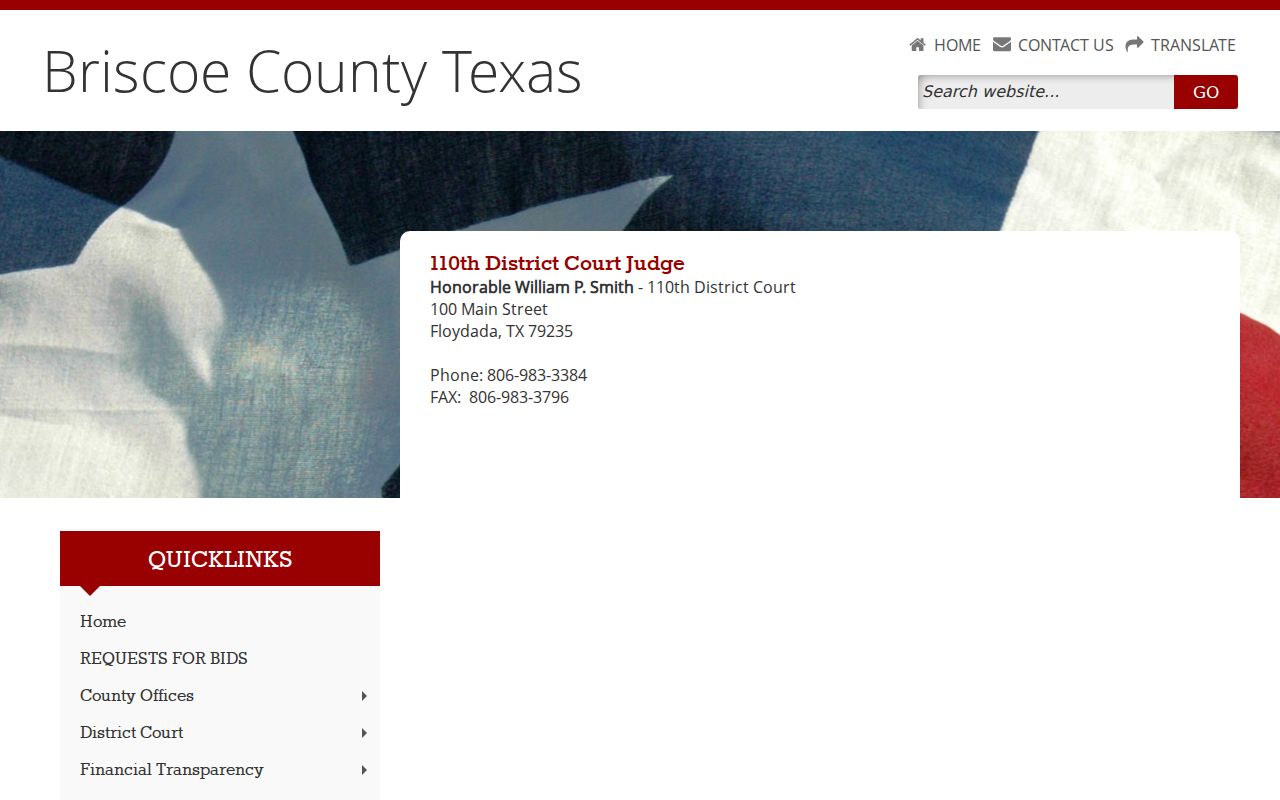
The image helps explain why a caller may reach Floydada even though the clerk maintains the underlying Briscoe County criminal case record in Silverton.
Searching Briscoe County Case Records
No official county public-search link was found. The reliable route begins with the combined clerk, followed by the appropriate justice court when the matter is fine-only. Supply enough detail to separate similar names and ask for distinct documents rather than a vague background report.
- Decide whether the likely level is felony, Class A or B misdemeanor, or a fine-only JP matter.
- Give the clerk the full name, approximate filing year, known offense, and cause number when available.
- Ask staff to check both county and district criminal indexes if the level is uncertain.
- Request the docket sheet, charging instrument, bond orders, judgment, sentence, and disposition by name.
- Ask for the copy, search, and certification quote before ordering; no criminal-copy price was confirmed in the research.
The combined clerk's official page gives the current office channel and payment links.
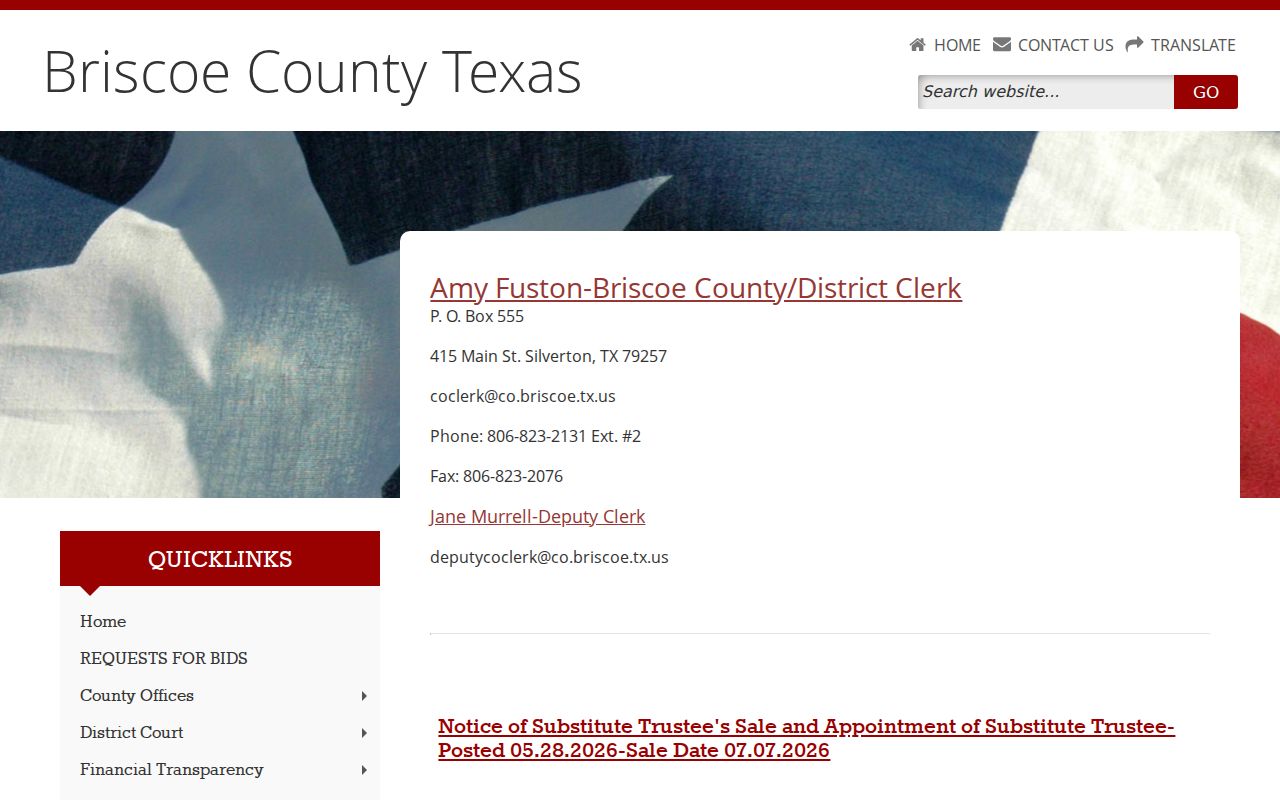
Its combined-office structure is useful, but requesters still need to identify the correct criminal index and document set.
Briscoe Case Terminal and re:SearchTX
An official 2019 county records plan said the clerk stored court documents electronically, maintained a public terminal, and backed up images offsite each day. It also reported more than 5,000 civil and criminal action files. That supports an in-office electronic search, not a promise that every older Briscoe County criminal case is fully imaged.
re:SearchTX is Texas's statewide court platform. Participation, user role, and document availability affect results, so the clerk remains the authoritative fallback.
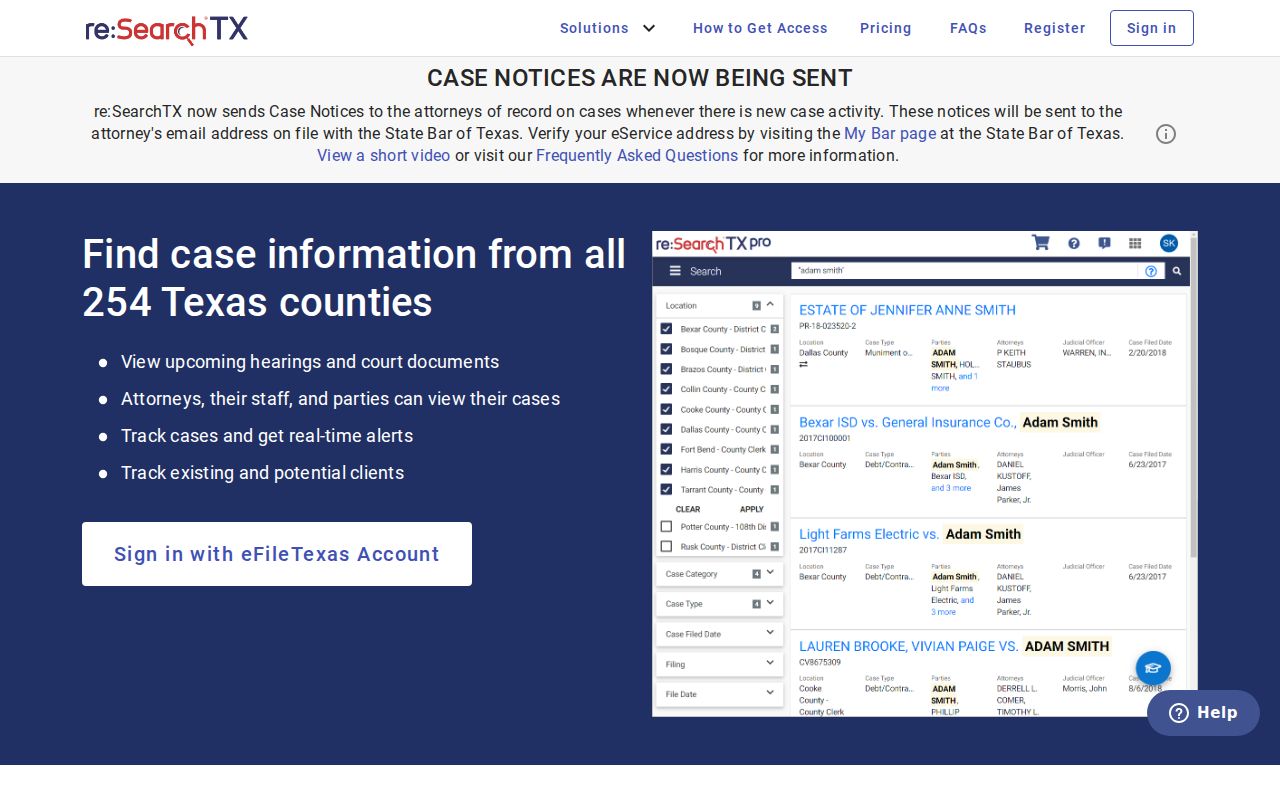
The statewide screen can help locate participating-court material, but an empty result does not prove that Briscoe County has no case.
| Search control | Type | Use |
|---|---|---|
| Email and password | Login | Required for account features |
| Person or business | Text | Name search where participating data exist |
| Case number | Text | Direct alternative when the exact cause number is known |
| Court or county | Filter | Select Briscoe when offered |
| Date range or case type | Filter | Narrows available results |
Inside a Briscoe County Case File
A Briscoe County criminal case file follows one prosecution rather than a person's whole history. The useful pieces establish what was alleged, what occurred on the docket, and how the court resolved each charge.
| Cause number and court | Identify the individual prosecution and the court exercising jurisdiction. |
|---|---|
| Charging document | A complaint, information, or indictment states the charge actually filed. |
| Docket entries | Chronological filings, settings, appearances, motions, and orders. |
| Bond orders | Release terms and later changes recorded in the court file. |
| Disposition and judgment | Dismissal, acquittal, deferred adjudication, or judgment of guilt. |
| Sentence and costs | Confinement, fine, community supervision, conditions, and financial entries where public. |
A certified disposition is especially important when a Texas DPS record lacks the final result. DPS requires the certified court document for that correction process.
Briscoe Charges From Filing to Prosecution
The arresting officer's allegation is not necessarily the charge that reaches a Briscoe County criminal docket. Prosecutors can decline, reduce, enhance, or replace it through an information or indictment. Felony work routes through the 110th District Attorney in Floydada. Appropriate misdemeanor prosecution routes through the Briscoe County Attorney Pro Tem in Silverton.
The district attorney page identifies the felony prosecutor's office.
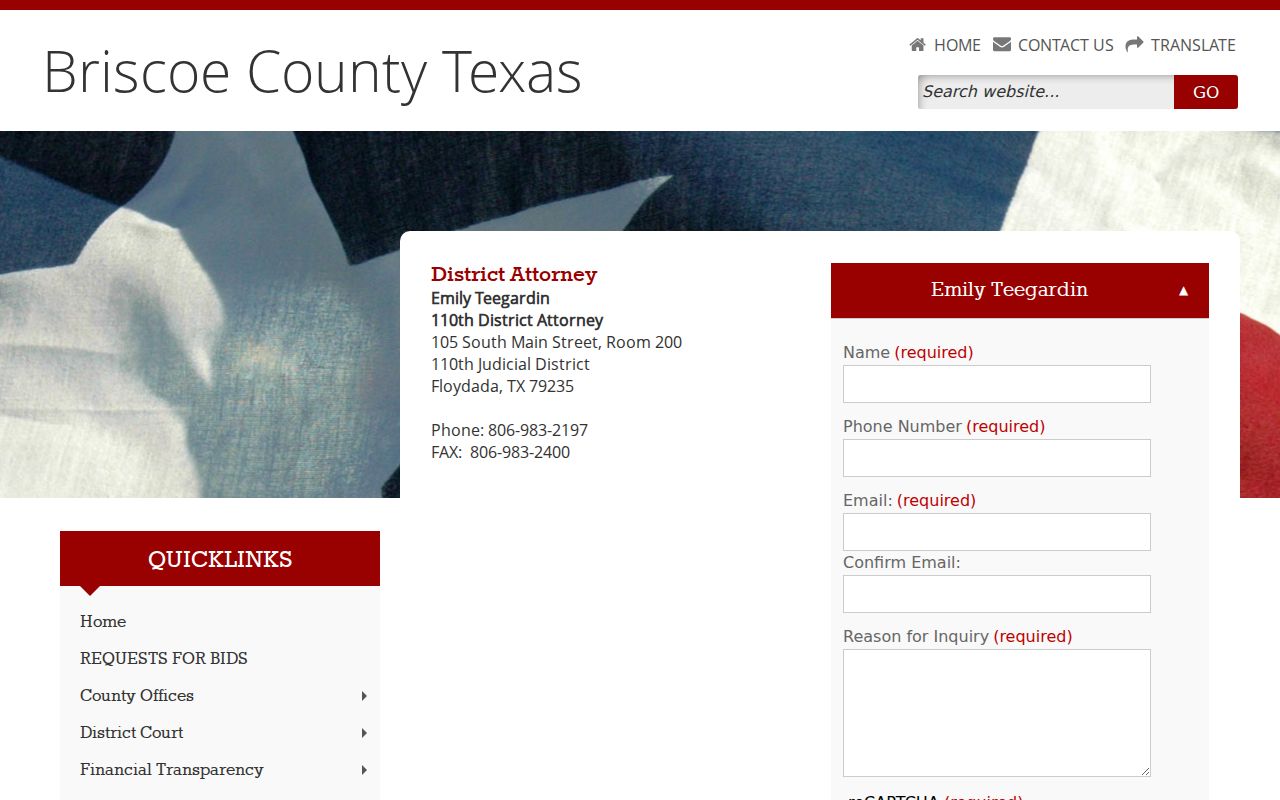
This separate Floydada office is part of the four-county structure, while filed Briscoe documents remain with the clerk.
The county attorney page supplies the local misdemeanor prosecution contact.
Together, these offices show why the filed charge and the arrest charge must be read as separate stages.
How a Briscoe Criminal Case Moves
A felony can begin with arrest and magistration, then proceed through complaint, prosecutor review, grand-jury indictment or a lawful waiver route, arraignment, pretrial work, plea or trial, judgment, sentence, and possible appeal. Texas law generally requires an arrested person to be taken before a magistrate without needless delay and no later than 48 hours. Magistration includes warnings, counsel issues, probable cause, and bail. It is not the later arraignment in the trial court.
Case flow: Charges Filed › Arraignment › Pretrial › Plea or Trial › Disposition › Sentencing
The official County Court page identifies the local court that ordinarily handles higher misdemeanors.
The court page should be paired with the clerk record, since the clerk rather than the judge's contact page holds the filed docket.
Reading Briscoe Dispositions Correctly
Several terms change the meaning of a Briscoe County case result. A dismissal ends the prosecution without a conviction but does not erase the related arrest. An acquittal is a not-guilty result after trial or directed verdict. Deferred adjudication postpones a finding of guilt while the person completes community supervision; it is not a conventional conviction, yet DPS makes deferred-adjudication information public unless legal relief applies.
- Indictment
- A grand jury's true-bill felony charging instrument.
- Information
- A prosecutor-signed charging instrument commonly used in misdemeanor court.
- Docket
- The ordered list of filings, settings, and court actions.
- Disposition
- The outcome attached to a charge.
- Judgment
- The formal court decision, including guilt and sentence when applicable.
Always match the disposition to the specific charge. One Briscoe case can contain more than one count with different results.
When a Briscoe Case Is Missing
A recent arrest may not yet have produced a filed Briscoe County criminal case. Start with the arresting agency for the report, then check the clerk again after prosecutor review. If the event was fine-only, contact JP1 or JP2 rather than assuming the combined clerk's district index will show it. For older files, ask whether archive retrieval or the courthouse terminal is needed.
Readers tracing an arrest before filing can use the county's arrest lookup process to identify the arresting agency and outside receiving jail.
Case Record Access & Restrictions
Texas court records are generally accessible under judiciary rules, subject to sealing and confidentiality. The Texas Public Information Act is useful for executive and local agency records, but it does not replace the clerk's court-record procedure. Juvenile matters, expunged files, sealed material, protected victim or minor information, financial identifiers, and some active-investigation information can be closed or redacted.
A nondisclosure order limits ordinary public dissemination without destroying every official record. Expunction under current Texas Code of Criminal Procedure Chapter 55A can direct destruction or return of qualifying arrest records. Neither remedy should be inferred from a missing online result. Ask the clerk about the specific cause and obtain the order when legal status matters.
The Texas Attorney General's open-government resources explain the public-information process for agency records.
Note: Verify every name match against the court and case number before treating it as the intended person's record.